Physician guide to daily low-dose tadalafil: how it works, who it's right for, the 2024 cardiovascular findings, and how it compares to as-needed use.
Physician guide to daily low-dose tadalafil: how it works, who it's right for, the 2024 cardiovascular findings, and how it compares to as-needed use.
Physician guide to daily low-dose tadalafil: how it works, who it's right for, the 2024 cardiovascular findings, and how it compares to as-needed use.
Daily Low-Dose Tadalafil: What the Evidence Shows for Sexual and Cardiovascular Health
Daily Low-Dose Tadalafil: What the Evidence Shows for Sexual and Cardiovascular Health

Stephen Ratcliff, MD
Chief Medical Officer
Daily Tadalafil — Sexual Health & Cardiovascular
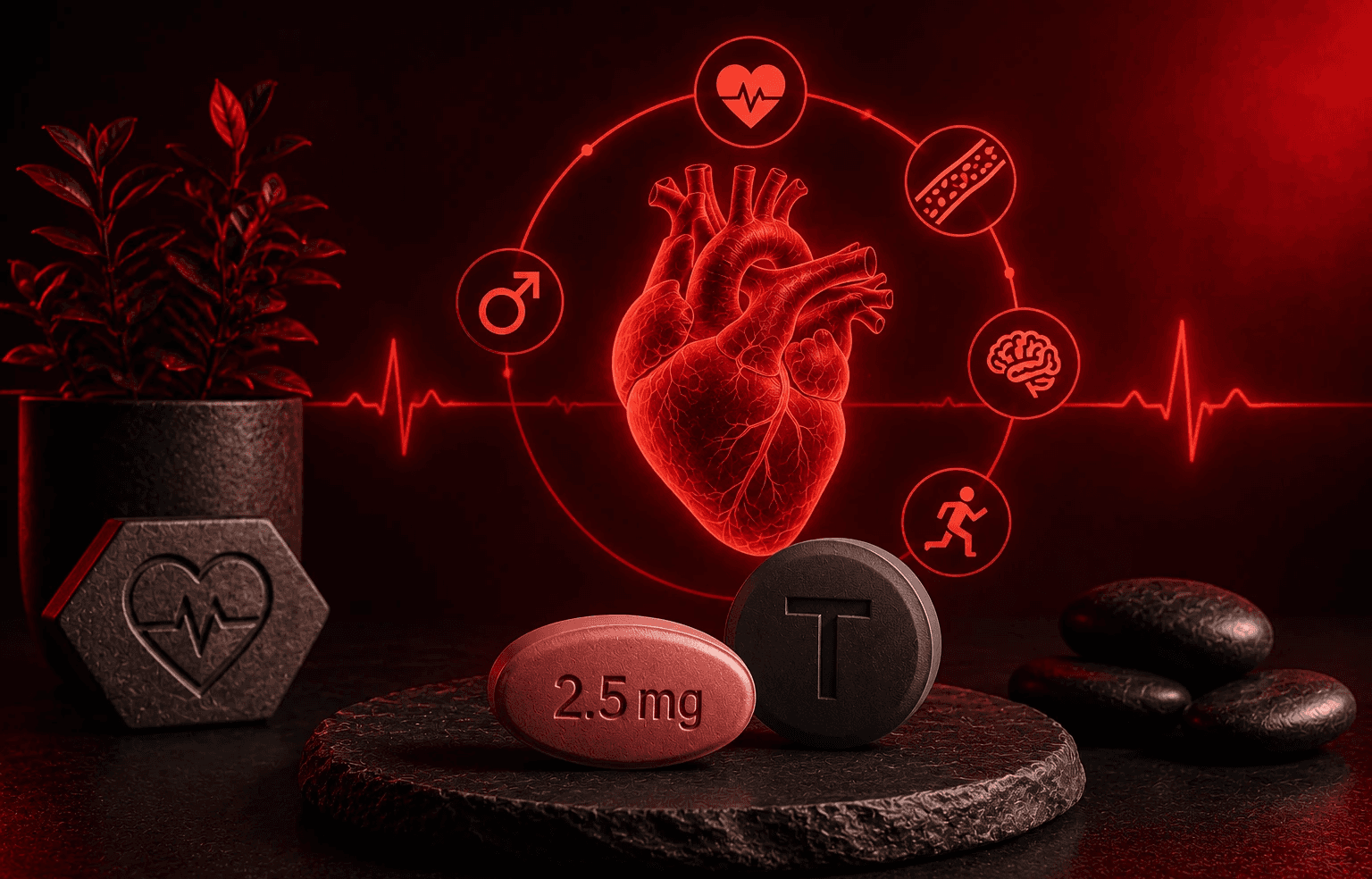
Image is AI-generated and does not represent actual results.
Stephen Ratcliff, MD
Chief Medical Officer
Daily Tadalafil — Sexual Health & Cardiovascular
Image is AI-generated and does not represent actual results.
Stephen Ratcliff, MD
Chief Medical Officer
Daily Tadalafil — Sexual Health & Cardiovascular
Image is AI-generated and does not represent actual results.
Key takeaways
Erectile dysfunction is often the first clinical sign of cardiovascular disease — they share the same underlying problem of blood vessel dysfunction. A 2024 study in over 1 million men found that PDE5 inhibitors like tadalafil were associated with meaningful reductions in mortality, heart attack, and stroke. Daily low-dose tadalafil is no longer just a sexual health tool. Here is what the evidence shows, who is a good candidate, and what to discuss with a physician.
Erectile dysfunction is often the first clinical sign of cardiovascular disease — not because one causes the other, but because both reflect the same underlying problem: blood vessels that are not working the way they should.
This is why the 2024 study in the American Journal of Medicine, which looked at over one million men and found that PDE5 inhibitor use was associated with a 34% reduction in all-cause mortality and a 27% reduction in heart attacks, is more than just a footnote in the urology literature. It changes the conversation.
Here is what we know, what we do not, and what to make of it as someone considering daily low-dose tadalafil.
Why ED Is a Cardiovascular Signal
The biological story is simple. An erection is a cardiovascular event: it requires healthy blood vessel walls (endothelium), responsive smooth muscle, and robust nitric oxide signaling. Heart attacks and strokes also depend on healthy endothelium and good nitric oxide signaling. When those systems start to fail, the penis often shows it first — the vessels there are smaller and notice problems earlier.
Clinically, this means ED in a man in his 40s or 50s is not just a quality-of-life issue. It is a clinical signal worth investigating. Addressing it is not just about the bedroom; it is one of the few cues we get from the body before something larger goes wrong.
How Tadalafil Works
Tadalafil is a PDE5 (phosphodiesterase type 5) inhibitor. It blocks the enzyme that breaks down cyclic GMP, the molecule that allows the smooth muscle in blood vessel walls to relax. The net effect: better blood flow in response to sexual stimulation.
Tadalafil's defining property compared with other PDE5 inhibitors is its half-life: about 17.5 hours, compared to 4 hours for sildenafil. That long duration is what makes daily low-dose use practical. At daily 2.5–5 mg dosing, tadalafil reaches steady-state plasma concentration in approximately 5 days. Instead of taking a pill before activity and waiting for it to kick in, daily dosing maintains a constant therapeutic level — which removes timing anxiety and supports spontaneity.
The 2024 Cardiovascular Data — What It Actually Showed
Published in the American Journal of Medicine in November 2024, the study analyzed over one million men aged 40+ in a national health database. Men using PDE5 inhibitors were compared with men not using them. Headline associations from the retrospective analysis, tadalafil-using subgroup:
34% lower all-cause mortality rate
27% lower heart attack incidence
34% lower stroke incidence
21% lower venous thromboembolism rate
32% lower dementia diagnosis rate
Two important caveats. First, these are association data, not proof of causation — men who fill PDE5 inhibitor prescriptions differ from men who do not in ways the analysis cannot fully control for. Second, the mechanistic plausibility (better endothelial function, reduced systemic inflammation, enhanced nitric oxide signaling) is strong enough that researchers and clinicians are taking the signal seriously rather than dismissing it.
The honest framing: tadalafil is not approved as a cardiovascular medication, and current evidence does not support prescribing it for that purpose. The mechanistic plausibility is real and the signal is interesting enough that the research community is taking it seriously, but the regulatory and evidentiary boundary between FDA-approved cardio drugs and tadalafil is one the data has not crossed.
Daily Low-Dose vs. As-Needed
There are two ways to prescribe tadalafil. As-needed dosing — typically 10mg to 20mg taken 30–60 minutes before activity — is the traditional approach. Daily dosing at a low dose (2.5mg or 5mg) builds a steady state in the body and provides continuous coverage.
Most men who use daily tadalafil prefer it. Reasons include the removal of timing-related performance anxiety, the lower per-dose side effect profile at the smaller daily dose, and the fact that the cardiovascular signal in the 2024 data was strongest with chronic use.
Daily low-dose is also FDA-approved for benign prostatic hyperplasia (BPH) symptoms. For men in their 50s and beyond with both ED and lower urinary tract symptoms, a single medication that addresses both is a meaningful clinical advantage.
Side Effects and Who Should Avoid Tadalafil
At low daily doses, tadalafil is generally well tolerated. The most common side effects are mild and transient: headache, flushing, mild back or muscle discomfort, nasal congestion, and occasional indigestion.
The absolute contraindication is concurrent use of nitrate medications — nitroglycerin, isosorbide dinitrate, isosorbide mononitrate. Combining the two can cause dangerous drops in blood pressure. Men taking nitrates for angina should never use any PDE5 inhibitor.
Alpha-blockers used for BPH (tamsulosin, alfuzosin, others) can interact with tadalafil. Co-prescription is not absolutely contraindicated but requires physician oversight to avoid stacked blood pressure effects. Men on standard blood pressure medications usually do fine on tadalafil but should have a physician involved.
Three rare but FDA-required safety mentions every patient should be aware of:
Priapism — an erection lasting more than 4 hours is a medical emergency. Seek immediate care.
Sudden hearing loss has been reported in rare cases with PDE5 inhibitors. Stop the medication and seek care if it occurs.
Non-arteritic anterior ischemic optic neuropathy (NAION) is a rare cause of sudden vision loss described in PDE5 inhibitor users, particularly those with vascular risk factors. Stop the medication and seek care if vision changes occur.
Tadalafil, Testosterone, and PT-141 — How They Fit Together
Sexual function depends on multiple systems. Low testosterone is a common contributor to erectile dysfunction and low libido — and checking testosterone before assuming PDE5 inhibitors will solve the problem is a reasonable step, particularly for men under 50 with new-onset ED.
For men who respond partially or not at all to PDE5 inhibitors, PT-141 (bremelanotide) — which is FDA-approved for premenopausal women with hypoactive sexual desire disorder and used off-label in men — works through a different mechanism: central nervous system pathways rather than blood flow. It is not a first-line tool, but it is an option worth knowing about for men who do not get a complete response from PDE5 inhibitors alone.
How Leader Health Approaches This
At Leader Health, daily tadalafil is offered as part of a physician-reviewed sexual health program — not as a one-click transaction. Your intake includes a hormone panel, a cardiovascular risk discussion, and a real conversation about what you are looking for. The medication is a tool; the program around it is what makes it work.
If you have been hesitant to talk to a urologist about ED, this is the start of the conversation — handled with the same clinical seriousness, on your own schedule.
References
Vakalopoulos I, et al. Erectile Dysfunction Medications and Reductions in All-Cause Mortality, Cardiovascular Events, and Dementia. Am J Med. 2024. PMID: 39532245.
UTMB Health News. Study Finds Erectile Dysfunction Medications Associated with Significant Reductions in Deaths, Cardiovascular Disease, and Dementia. November 2024.
American Urological Association. Erectile Dysfunction: AUA Guideline.
FDA. Cialis (tadalafil) prescribing information. accessdata.fda.gov.
Key takeaways
Erectile dysfunction is often the first clinical sign of cardiovascular disease — they share the same underlying problem of blood vessel dysfunction. A 2024 study in over 1 million men found that PDE5 inhibitors like tadalafil were associated with meaningful reductions in mortality, heart attack, and stroke. Daily low-dose tadalafil is no longer just a sexual health tool. Here is what the evidence shows, who is a good candidate, and what to discuss with a physician.
Erectile dysfunction is often the first clinical sign of cardiovascular disease — not because one causes the other, but because both reflect the same underlying problem: blood vessels that are not working the way they should.
This is why the 2024 study in the American Journal of Medicine, which looked at over one million men and found that PDE5 inhibitor use was associated with a 34% reduction in all-cause mortality and a 27% reduction in heart attacks, is more than just a footnote in the urology literature. It changes the conversation.
Here is what we know, what we do not, and what to make of it as someone considering daily low-dose tadalafil.
Why ED Is a Cardiovascular Signal
The biological story is simple. An erection is a cardiovascular event: it requires healthy blood vessel walls (endothelium), responsive smooth muscle, and robust nitric oxide signaling. Heart attacks and strokes also depend on healthy endothelium and good nitric oxide signaling. When those systems start to fail, the penis often shows it first — the vessels there are smaller and notice problems earlier.
Clinically, this means ED in a man in his 40s or 50s is not just a quality-of-life issue. It is a clinical signal worth investigating. Addressing it is not just about the bedroom; it is one of the few cues we get from the body before something larger goes wrong.
How Tadalafil Works
Tadalafil is a PDE5 (phosphodiesterase type 5) inhibitor. It blocks the enzyme that breaks down cyclic GMP, the molecule that allows the smooth muscle in blood vessel walls to relax. The net effect: better blood flow in response to sexual stimulation.
Tadalafil's defining property compared with other PDE5 inhibitors is its half-life: about 17.5 hours, compared to 4 hours for sildenafil. That long duration is what makes daily low-dose use practical. At daily 2.5–5 mg dosing, tadalafil reaches steady-state plasma concentration in approximately 5 days. Instead of taking a pill before activity and waiting for it to kick in, daily dosing maintains a constant therapeutic level — which removes timing anxiety and supports spontaneity.
The 2024 Cardiovascular Data — What It Actually Showed
Published in the American Journal of Medicine in November 2024, the study analyzed over one million men aged 40+ in a national health database. Men using PDE5 inhibitors were compared with men not using them. Headline associations from the retrospective analysis, tadalafil-using subgroup:
34% lower all-cause mortality rate
27% lower heart attack incidence
34% lower stroke incidence
21% lower venous thromboembolism rate
32% lower dementia diagnosis rate
Two important caveats. First, these are association data, not proof of causation — men who fill PDE5 inhibitor prescriptions differ from men who do not in ways the analysis cannot fully control for. Second, the mechanistic plausibility (better endothelial function, reduced systemic inflammation, enhanced nitric oxide signaling) is strong enough that researchers and clinicians are taking the signal seriously rather than dismissing it.
The honest framing: tadalafil is not approved as a cardiovascular medication, and current evidence does not support prescribing it for that purpose. The mechanistic plausibility is real and the signal is interesting enough that the research community is taking it seriously, but the regulatory and evidentiary boundary between FDA-approved cardio drugs and tadalafil is one the data has not crossed.
Daily Low-Dose vs. As-Needed
There are two ways to prescribe tadalafil. As-needed dosing — typically 10mg to 20mg taken 30–60 minutes before activity — is the traditional approach. Daily dosing at a low dose (2.5mg or 5mg) builds a steady state in the body and provides continuous coverage.
Most men who use daily tadalafil prefer it. Reasons include the removal of timing-related performance anxiety, the lower per-dose side effect profile at the smaller daily dose, and the fact that the cardiovascular signal in the 2024 data was strongest with chronic use.
Daily low-dose is also FDA-approved for benign prostatic hyperplasia (BPH) symptoms. For men in their 50s and beyond with both ED and lower urinary tract symptoms, a single medication that addresses both is a meaningful clinical advantage.
Side Effects and Who Should Avoid Tadalafil
At low daily doses, tadalafil is generally well tolerated. The most common side effects are mild and transient: headache, flushing, mild back or muscle discomfort, nasal congestion, and occasional indigestion.
The absolute contraindication is concurrent use of nitrate medications — nitroglycerin, isosorbide dinitrate, isosorbide mononitrate. Combining the two can cause dangerous drops in blood pressure. Men taking nitrates for angina should never use any PDE5 inhibitor.
Alpha-blockers used for BPH (tamsulosin, alfuzosin, others) can interact with tadalafil. Co-prescription is not absolutely contraindicated but requires physician oversight to avoid stacked blood pressure effects. Men on standard blood pressure medications usually do fine on tadalafil but should have a physician involved.
Three rare but FDA-required safety mentions every patient should be aware of:
Priapism — an erection lasting more than 4 hours is a medical emergency. Seek immediate care.
Sudden hearing loss has been reported in rare cases with PDE5 inhibitors. Stop the medication and seek care if it occurs.
Non-arteritic anterior ischemic optic neuropathy (NAION) is a rare cause of sudden vision loss described in PDE5 inhibitor users, particularly those with vascular risk factors. Stop the medication and seek care if vision changes occur.
Tadalafil, Testosterone, and PT-141 — How They Fit Together
Sexual function depends on multiple systems. Low testosterone is a common contributor to erectile dysfunction and low libido — and checking testosterone before assuming PDE5 inhibitors will solve the problem is a reasonable step, particularly for men under 50 with new-onset ED.
For men who respond partially or not at all to PDE5 inhibitors, PT-141 (bremelanotide) — which is FDA-approved for premenopausal women with hypoactive sexual desire disorder and used off-label in men — works through a different mechanism: central nervous system pathways rather than blood flow. It is not a first-line tool, but it is an option worth knowing about for men who do not get a complete response from PDE5 inhibitors alone.
How Leader Health Approaches This
At Leader Health, daily tadalafil is offered as part of a physician-reviewed sexual health program — not as a one-click transaction. Your intake includes a hormone panel, a cardiovascular risk discussion, and a real conversation about what you are looking for. The medication is a tool; the program around it is what makes it work.
If you have been hesitant to talk to a urologist about ED, this is the start of the conversation — handled with the same clinical seriousness, on your own schedule.
References
Vakalopoulos I, et al. Erectile Dysfunction Medications and Reductions in All-Cause Mortality, Cardiovascular Events, and Dementia. Am J Med. 2024. PMID: 39532245.
UTMB Health News. Study Finds Erectile Dysfunction Medications Associated with Significant Reductions in Deaths, Cardiovascular Disease, and Dementia. November 2024.
American Urological Association. Erectile Dysfunction: AUA Guideline.
FDA. Cialis (tadalafil) prescribing information. accessdata.fda.gov.
In this article
Frequently Asked Questions
Yes. Daily dosing at 2.5mg or 5mg is FDA-approved for both ED and BPH. It is the most common form of long-term tadalafil therapy in clinical practice.
A 2024 study of over one million men found PDE5 inhibitor use, including tadalafil, was associated with significant reductions in mortality, heart attack, and stroke. The association is strong and mechanistically plausible, but tadalafil is not currently FDA-approved as a cardiovascular medication.
Both are PDE5 inhibitors. Sildenafil has a 4-hour half-life and is taken as needed; tadalafil's 17.5-hour half-life makes daily low-dose use practical and reduces timing anxiety. Tadalafil also has FDA approval for benign prostatic hyperplasia.
Tadalafil does not cause physical dependence. Some men develop a psychological reliance — feeling like they need it to perform — which is worth discussing with a physician. It can usually be addressed alongside the medication, not by stopping it.
Most antihypertensives are compatible with tadalafil at low doses, but the combination requires physician oversight to avoid dose stacking. The exception is nitrate medications, which are an absolute contraindication.
No, but low testosterone is a common contributor and is worth checking. The two often coexist and are best evaluated together rather than independently.
About Medical Reviewer
Stephen Ratcliff, MD
Stephen Ratcliff, MD
Stephen Ratcliff, MD
CMO of Leader Health
CMO of Leader Health
Stephen Ratcliff, MD is the Chief Medical Officer of Leader Health and the board-certified physician responsible for clinical governance, medical content review, and regulatory oversight across the platform. Every article on the Leader Health blog is reviewed and approved by Dr. Ratcliff before publication.
Stephen Ratcliff, MD is the Chief Medical Officer of Leader Health and the board-certified physician responsible for clinical governance, medical content review, and regulatory oversight across the platform. Every article on the Leader Health blog is reviewed and approved by Dr. Ratcliff before publication.
Stephen Ratcliff, MD is the Chief Medical Officer of Leader Health and the board-certified physician responsible for clinical governance, medical content review, and regulatory oversight across the platform. Every article on the Leader Health blog is reviewed and approved by Dr. Ratcliff before publication.
All related stories post
All related stories post
All related stories post
Lorem ipsum dolor sit amet, consectetur adipiscing elit, sed do eiusmod tempor.
Lorem ipsum dolor sit amet, consectetur adipiscing elit, sed do eiusmod tempor.


What Every Woman Should Know About Hormone Replacement Therapy in Perimenopause — and Why Most Doctors Don't Tell You
What Every Woman Should Know About Hormone Replacement Therapy in Perimenopause — and Why Most Doctors Don't Tell You
Stephen Ratcliff, MD
Chief Medical Officer
Physician-authored guide to HRT in perimenopause: the WHI study corrected, delivery options, timing window, and what the current evidence actually supports.

Testosterone Replacement Therapy: A Physician's Evidence-Based Guide to TRT in 2026
Testosterone Replacement Therapy: A Physician's Evidence-Based Guide to TRT in 2026
Stephen Ratcliff, MD
Chief Medical Officer
Physician-led guide to TRT: when it's appropriate, lab workup, dosing protocols, monitoring, fertility considerations, and what stopping looks like.

GLP-1 Medications for Weight Management: A 2026 Evidence-Based Patient Guide
GLP-1 Medications for Weight Management: A 2026 Evidence-Based Patient Guide
Stephen Ratcliff, MD
Chief Medical Officer
Physician-written GLP-1 guide: how the medications work, who they're for, side effects, muscle preservation, and what to know about access in 2026.
Science-led care for better living
Proven treatments for weight, hormones, and energy — without the guesswork. Just real, lasting results.
Science-led care for better living
Proven treatments for weight, hormones, and energy — without the guesswork. Just real, lasting results.
Science-led care for better living
Proven treatments for weight, hormones, and energy — without the guesswork. Just real, lasting results.
Backed by Science, Built for You Personalized, Trusted, Proven.

hello@leaderhealth.com

Men's HRT
Longevity
Quick Links

Backed by Science, Built for You Personalized, Trusted, Proven.
hello@leaderhealth.com
Men's HRT
Longevity
Quick Links
Backed by Science, Built for You Personalized, Trusted, Proven.
hello@leaderhealth.com
Men's HRT
Longevity
Quick Links